 |


|
#101
 07-02-2007, 16:30
|
||||
|
||||
 Re: SAMANDAN EVRiM SORUSU
Bak,i bir sürü zırva, yalan, safsata yapıyorsun, sonra bizim yazdığımıza küfür, hakaret diyorsun..
***Darwin *bir *dinozorun *sineği *yakalamaya *çalışırken *kanatlandığını *iddia *ederken, *sineğin *zaten *mükemmel *bir *kanat *ve *uçuş *sistemine *sahip *olarak *saniyede *1000 *kere *kanat *çırpıyor *olduğunu *düşünmezler. * * * Bak şurada darwin'in evrim toerisinin son baskısı var: http://www.literature.org/authors/da...s-6th-edition/ Burada Darwin nerede böyle bir şey söylüyor? Bul, gel dilediğini bana yap, bulamazsan sadece kafanı en yakın klozete sokar mısın? >>> ***Darwin *yeryüzündeki *tüm *canlılığı *meydana *getirdiğini *iddia *ettikleri *atomların *şuursuz *varlıklar *olduğunu *düşünmezler. Atomlar şuursuz filan değildir, yeterince şuurludurlar.. Ama Darwni yeryüzündeki canlılığı atomların meydana getirdiğinide düşünmüş değildir.. >>> ***Darwin, *fosfor, *karbon *gibi *atomların *tesadüfler *sonucunda *biraraya *gelerek, *yıldırımlar, *volkanlar, *ultraviyole *ışınları, *radyasyon *gibi *doğal *olaylar *sonucunda *kendilerini *kusursuzca *organize *ederek *proteinleri, *hücreleri, *balıkları, *kedileri, *tavşanları, *aslanları, *kuşları, *insanları *ve *tüm *canlılığı *meydana *getirdiklerini *iddia *ederken *bunların *bilinçsiz, *akılsız, *yeteneksiz, *bilgisiz *ve *cansız *olduklarını *düşünmezler. * Canlılar acayip derecede kusurludur öncelikle.. Ve bilim bunlara tesadüf filan demez.. Senin 400 milyon spermden biri olarak bu hale gelmiş olman ne kadar tesadüfse, bu da o kadar tesadüftür.. >>> ***Darwin *canlılığın *mutasyonlar *sonucunda *evrimleştiğini *iddia *ederken * mutasyonların *%99’unun *canlılara *zarar *verdiğini *düşünmezler. Geri kalan %1'i yeterde ondan, çünkü canlılar her zaman yaşayabilecek olandan çok fazlasını doğurur/üretirler.. >>> ****Darwinistler *evrim *teorisinin *1800lü *yılların *teknolojik *durumu *içerisinde *ortaya *atılmış *kör *bir *teori *olduğunu *düşünmezler. Evet, doğru.. 2000 li yılların teknolojisi evrimi teori değil, gerçek olarak ortaya koymuştur. Darwinin de çizgisel evrim diyerek yanıldığı, evrimin çizgisel değil düzlemsel olduğu görülmüştür.. >>> ****Darwinistler *türlerin *birbirinden *evrimleştiğini *iddia *ederken *fosil *katmanlarında *bunu *destekleyecek *tek *bir *delil *elde *edilemediğini *düşünmezler Bulunan tüm fosiller bunu %100 desteklemektedir.. >>> ****Darwinistler *canlı *türlerinin *birbirlerinden *uzun *zamanlar *içinde *evrimleşerek *çoğaldıklarını *iddia *ederken *bugün *bilinen *temel *canlı *kategorilerinin *tamamına *yakınının, *530-520 *milyon *yıl *önce, *"Kambriyen *Devri" *adı *verilen *jeolojik *devirde *aynı *anda *ve *aniden *ortaya *çıktıklarını *düşünmezler. Yanlış.. Kambriyende bir sürü canlı birden ortaya çıkmaz, bir sürü canlı birden fosilleşmeye başlar. Çünkü, bir kabuk/omurga evrimi yaşamışlardır.. >>> ***Darwinistler, *fosil *kayıtlarının *canlıların *milyonlarca *yıldır *hiçbir *değişime *uğramadıklarını *ispat *ettiğini *düşünmezler. Milyonlarca yıldır aynı koşullarda kalmış bir canlı başka bir yönde evrim geçiremez.. Eğer koşullar değişmiyorsa, canlıda aynı kalır.. >>> ***Darwinistler *19. *yy *teknolojisi *ile *su *dolu *bir *balon *olarak *gördükleri *tesadüfen *oluştuğunu *iddia *ettikleri *hücrenin *bilim *adamlarının *benzetmesiyle, *New *York *şehri *kadar *kompleks *bir *yapıya *sahip *olduğunu *düşünmezler. Yanlış, new york şehri daha kompleks bir yapıya sahiptir.. Hatta bir kar tanesi bile daha komplekstir.. Dahası, bunun senin dediğin gibi olması da hiç bir anlam ifade etmez.. >>> ***Darwinistler *milimetrenin *100'de *biri *büyüklüğünde *olan *hücrelerimizin *içindeki *"mitokondri" *isimli *enerji *santralinin, *bir *petrol *rafinerisinden *ya *da *bir *hidroelektrik *santralinden *daha *kompleks *olduğunu *düşünmezler. Gene yanlış.. Mitokondri bir enerji santralinden daha basittir. O kadar ki, kendi kendine işler, ama santral kendi kendine işleyemez.. Bir sürü yalan, yanlış işte, başka bir şeyin var mı? Birde üstüne utanmadan "ben evrim kitabı yazarımda" filan diyorsun.. Hadi anlat bakalım bize, mtDNA nasıl bir şeydir? Bir halt biliyor musun görelim? Madem cahilliğine bakmadan mitokondri vs. diyebiliyorsun? Hadi, bekliyoruz.. Piltdown adamı mı? Sen şunlara bir cevap ver, bu arada şurayı biraz oku: http://www.infoplease.com/ipa/A0001819.html Ondan sonra görüşürüz.. 
|


|
#102
07-02-2007, 16:35
|
||||
|
||||
|
Re: SAMANDAN EVRiM SORUSU
Ponginae, Primates (primatlar) takımının Hominidae (büyük insansı maymunlar) familyasını oluşturan iki alt familyadan biridir. Hominidae familyasını Homininae alt familyasıyla paylaşan Ponginae içinde sınıflanan cinslerden yalnızca Pongo (orangutan) günümüzde varlığını sürdürmektedir. Soyu tükenmiş olanlar, yaş konakları sırasıyla Miyosen ve Pleistosen olan fosil cinsler olarak Sivapithecus ve Gigantopithecus'dur.
 *****Neye benziyor maymun bunun soyu tükenmiş bir insan ırkı olarak gösteriyorlar..Kardeşim ortada değil mi soyu tükenmiş bir maymun türlerinden...(yani Şempo  *) *)Eski dünya kuyruksuz maymunlarından 7 – 7,5 milyon yıl önce soyu orangutan’a varacak olan pongidler cinsi ayrılmıştır Ponginae Homininae – insan türüne giden yol Homininae *6 milyon yıl önce günümüzün goril şempaze cinslerini oluşturan atalar ayrılmıştır Gorillini Unassigned Homininae Hominini – insan türüne giden yol Hominini *Günümüzden 5 milyon yıl önce homininilerin yolu ayrılmıştır. Panina Hominina – insan türüne giden yol Hominian *4,5 milyon yıl önce iki ayağının üzerinde duran hominianlar ortaya çıkmıştır. Ardipithecus Australopithecus – Yakın hayvan atalarımızın kuzeni Kenyanthropus Orrorin Paranthropus Sahelanthropus Ramapithecus – Yakın hayvan atamız. İnsanın bilinen en eski soyu ve ilk homo türlerinin ortak atası. Homo Homo *Homo cinsi 3 milyon yıl önce hominianlardan ayrılmıştır. Homo antecessor Homo cepranensis Homo erectus – Homo habilisten türemiş uzak insan atamız Homo ergaster Homo floresiensis Homo georgicus Homo habilis – Uzak insan atamız Homo heidelbergensis Homo neanderthalensis Homo rhodesiensis Homo rudolfensis Homo sapiens – Yakın insan atamız Homo sapiens sapiens -- Günümüz insanı Soyu tükenmiş maynunun kalıntılarını insan kalıntı diye gösteriliyor..Ortada bir evrim ne kardeş bana bu maymunu insan atası olarak gösteremezsin...Olmaz nerde biliyorsun insan atası,belkide soyu tükenmiş bir maymundur..FOSİL BLUNTULARINDA BİR KEMİK BULUNUYOR YADA BİR İSKELET TAMAM BULDUM...BULDUM...DUR NE Yİ BULDUN DEMEYE KALMADAN EVRİM İSPATLANDI BUZ DEVRİ 1,2, SİNAMALARDA..... *  * * * * * * SOYU TÜKENMİŞ BU MAYMUNLARIN YANLARINDA BİR KALINTI BULUNMAMIŞ ....NE BİR SİLAH..NE BİR ARAÇ GEREÇ..BUNLAR INSAN KALINTILARI İSE BUNLARIN YANINDA KULANDIĞI MALZEME BULUNMASI GEREKLİDİR... [Mt]METEE[/Mt]Kalp ne ile doluysa,dudaklardan 0 dökülür gider.Goethe EVRiM HAYALGüCüDüR?...
|

|
#103
07-02-2007, 16:43
|
||||
|
||||
|
Re: SAMANDAN EVRiM SORUSU
Sayın Metee "cilt cilt" tez yazmayı boşverin. Ama birilerinin yazısını alıp copy/paste yaparken en azından bu çalışmayı yapan insanlara
saygı olarak isim ve link verin. Yazdığınızı iddia ettiğiniz metin bir çok forumda ve ödev sitesinde dolaşan neredeyse "anonim" bir çalışma. frodo meteenin cilt cilt copysinden sadece biri SANA CİLT CİLT TEZ YAZARIM...SEN ANCAK DARWİN KİTABINA BAĞLI KAL...BEN SANA BU EVRİM KİTAPLARININ ESKİ VE YENİSİNİ GÖNDEREYİM..KENDİ BU ALANDA UZMAN ZANNEDEN TEK SEN VARSIN.. [Mt]METEE[/Mt]Kalp ne ile doluysa,dudaklardan 0 dökülür gider.Goethe EVRiM HAYALGüCüDüR?...
|
|
#104
07-02-2007, 17:08
|
||||
|
||||
|
Re: SAMANDAN EVRiM SORUSU
Şaman efendi, sana kim soyu tükenmiş maymunu insan atası diye gösteriyor? Bir sürü saymışsın, hepsi çeşitli primatlardan biri.. Kim sana orangutanı insan atası diye gösteriyor?
Soyu tükenmiş maymun? Acaba soyu insan olmuş maymun olasın? mtDNA? Bir sürü bir yerden yapıştırmışsın.. Kime ne anlatıyorsun ki? DNA'nın kromozomlara yayılımı nasıl olur desem, oturup kalacaksın.. Elin aklı ile gerdeğe girilmez.. Dağıtma konuyu, anlat bakalımi mtDNA nedir? Bir cümle ile değil, nerede bulunur, ne olur, nerden çıkar vs. vs. Madem mitokondriyi pek iyi biliyorsun, hadi görelim?
|
|
#105
07-02-2007, 18:07
|
||||
|
||||
|
Re: SAMANDAN EVRiM SORUSU
"Mitokondriyal DNA.
Genleri fosil olarak düşünün.Hücrelerde, bilinen DNA dışında, mitokondri denilen enerji motorlarında ayrı bir DNA halkası var. Mitokondriyal DNA (mtDNA), bilinen –çekirdekte bulunan ve eşeyli üreme sırasında parçalanıp yeniden birleşen– DNA'dan farklı olarak, anneden çocuğa bir bütün olarak geçer." ***mtDNA göre insanların atası ayrı kıtalardan gelmişlerdir..Yani bir Eskimo ve Aborjin nasıl ayrı kalmışlardır, diye bir tabloda kullanıyorlar..Bu olguyu ortaya atan kişi fosillerde mtDNA alması gerektini söylüyor.. **mtDNA göre atalarımız aynı kıtalardan değilde ayrı kıtalardan gelmiştir...Buna kim inanır bilmem... "Hatalar o kadar yaygın olabilir ki genetikçiler insan popülasyonları ve evrim çalışmalarında yanlış sonuçlara varıyor olabilirler. Forster’ın, dizilimlerin değişimine göre oluşturulan evrim ağaçlarını kapsayan hata-araştırma yöntemi, bu hataların çapını eksik tahmin ediyor olabilir." Carina Dennis: http://www.nature.com/ Kod:
The good news is that a very large number of human mtDNA sequences from diverse populations and ethnic groups are becoming available for analysis. The bad news is that many of these sequences contain errors (Dennis 2003; Forster 2003). In at least one instance, that of the Icelandic population, it appears that mtDNA sequence errors were a contributing factor (although not the only one) to an erroneous conclusion about the genetic diversity of these people (Arnason 2003). Forster (2003) cites other examples where mtDNA sequence errors have compromised analyses of population genetics and human evolution. In a reanalysis of mtDNA sequences in the Ladin population of the Alps, the original conclusions on population diversity were not overturned after the use of more accurate sequences (Vernesi et al. 2002). At this point, we do not know the extent of the damage, so to speak, caused by mtDNA sequence errors. Nevertheless, it is clear that correcting such errors must be undertaken as quickly as possible. As a result of our reduced median network analyses (Herrnstadt et al. 2002), we released a database of 560 human mtDNA coding region sequences. A small number of errors in these sequences were detected by Dr. Hans-Jürgen Bandelt, and we were able to correct these, as noted in an erratum that was published soon after our original report (Herrnstadt et al. 2002). Subsequently, a systematic approach to the detection of phantom sequence errors was published in this Journal (Bandelt et al. 2002). As defined by these investigators, phantom errors are those that arise during the sequencing process itself. Dr. Bandelt contacted us again and suggested that there were phantom mutations in our mtDNA database. Specifically, the likely errors involved G→C transversions at nt 7927 and nt 7985. Such a result was surprising to us, because we believed that our sequencing approach and quality control measures had avoided such errors. Therefore, we used Dr. Bandelt’s information as a starting point for a comprehensive reanalysis of our database. After reanalysis, which included inspection of the electropherograms for all G→C and C→G transversions, we found that 41 of these mtDNA sequences contained at least one such phantom error. In fact, there were more such phantom errors than those suggested by Dr. Bandelt. In addition to the phantom transversions at positions 7927 and 7985, we detected instances of other such errors that included ones at nucleotide positions 500, 14160, 14460, 14974, and 16239. However, these errors did not occur randomly throughout the database. Instead, we could “isolate” the errors to a short time period that was relatively early during our large-scale mtDNA sequencing program. With the benefit of hindsight, it appears that the frequency of these errors was caused by two technical factors (see also Bandelt et al. 2002). The first was that one particular capillary array of the ABI 3700 DNA Analyzer produced suboptimal base separations, whereas the second was that the sequencing chemistry at that time utilized an early version of reagents that was optimized subsequently. In addition to these 41 sequences, we also found that an additional 26 mtDNA sequences contained errors that arose during data entry or editing. As a result of this reanalysis, we have corrected the database of 560 sequences, which is available through the MitoKor Web site (the URL address is given below). Have these errors invalidated our network analyses? Not to a substantial degree. Many of the sequence errors generated private polymorphisms, which were not included in our analyses. Furthermore, a substantial proportion of the branches in these networks were established by multiple substitutions (see figs. 1–4 in Herrnstadt et al. 2002), and, so far, we have no evidence from additional network analysis that the original results need major revision. Can we now guarantee that our mtDNA database is error free? No. Although such is our goal, it is not practical, and it is probably not technically feasible. It is now clear that many mtDNA databases or sequence sets contain errors (Forster 2003). The solution to this problem is further effort, both at the front end (the sequencing process itself) and at the back end (increased quality control) of mtDNA database construction. http://www.pubmedcentral.nih.gov/art...?artid=1180320 Kod:
Just when evolutionists thought it couldn’t possibly get any worse—it has! Toward the end of 2002, we authored an article for the Apologetics Press Web site titled “The Demise of ‘Mitochondrial Eve.’ ” In that article, we noted how rapidly things can, and often do, change in science. As an example of that fact, we discussed the well-known evolutionary icon, “Mitochondrial Eve,” a woman who was alleged to have lived in Africa at the beginning of the Upper Pleistocene period (between 100,000 and 200,000 years ago). Eve had been described as the most-recent common ancestor of all humans on Earth today. In fact, in mid-2002, some evolutionists still were touting her as exactly that—in spite of overwhelming scientific evidence to the contrary. Geneticist Spencer Wells, in his book, The Journey of Man: A Genetic Odyssey, referred to Eve as “a real person who lived at that time—the common ancestor of everyone alive today” (2002, p. 54). Spencer went on to inform his readers: “Crucially, though, the fact that a single ancestor gave rise to all of the diversity present today does not mean that this was the only person alive at the time—only that the descendant lineages of the other people alive at the same time died out” (p. 32). This makes a great “just-so” story. But is any of it true? As we pointed out in our article on “The Demise of ‘Mitochondrial Eve,’ ” no, it’s not. The scientists who performed the original work that led to the creation of Eve (see Cann, et al., 1987) used estimates of the frequency of mutations that occur in the DNA within a cell’s mitochondria, in an attempt to determine how far back in time our alleged “most-recent common ancestor” could be traced (an explanation of how this works follows below). In performing this work, the researchers assumed that all of the DNA in the cell’s mitochondria had been passed down generation by generation only by the female. Other evolutionists who performed similar studies continued to make that same assumption—until reports began appearing in 1999, documenting that mitochondrial DNA also can be (and often is) passed down generation to generation by the male. This information destroyed the basic assumption upon which “Mitochondrial Eve” had been built—and led to her “demise.” But we’re getting ahead of ourselves. Before we answer whether or not there is any truth to the type of “just-so” scenarios like the one posed by Spencer Wells, a brief history lesson might be appropriate. On the first day of 1987, a new “discovery” seized the attention of the popular press. The original scientific article that caused all the commotion—“Mitochondrial DNA and Human Evolution”—appeared in the January 1, 1987 issue of Nature, and was authored by Rebecca Cann, Mark Stoneking, and Allan C. Wilson (see Cann, et al., 1987). These three scientists announced that they had “proven” that all modern human beings can trace their ancestry back to a single woman who lived 200,000 years ago in Africa. This one woman was nicknamed “Eve” (a.k.a., “Mitochondrial Eve”)—much to the media’s delight. An article in the January 26, 1987 issue of Time magazine bore the headline, “Everyone’s Genealogical Mother: Biologists Speculate that ‘Eve’ Lived in Sub-Saharan Africa” (Lemonick, 1987). A year later, that “speculation” became a major Newsweek production titled “The Search for Adam and Eve” (Tierney, et al., 1988). The provocative front cover presented a snake, tree, and a nude African couple in a “Garden of Eden”-type setting. The biblical-story imagery was reinforced by showing the woman offering a piece of fruit to the man. A word of explanation is in order at this point. For decades, evolutionists had been trying to determine the specific geographical origin of humans—whether we all came from one specific locale, or whether there were many small pockets of people placed around the globe. When they set out to determine the specific geographical origin of humans, a curious piece of data came to light. As they considered various human populations, Africans seemed to show much more genetic variation than non-Africans (i.e., Asians, Europeans, Native Americans, Pacific Islanders, et al.). According to molecular biologists, this increased variability is the result of African populations being older, thus, having had more time to accumulate mutations and diverge from one another. This assumption led some researchers to postulate that Africa was the ancient “cradle of civilization” from which all of humanity had emerged. The genetic material (DNA) in a cell’s nucleus controls the functions of the cell, bringing in nutrients from the body and making hormones, proteins, and other chemicals. Outside the nucleus is an area known as the cytoplasmic matrix (generally referred to simply as the cytoplasm), which contains, among other things, tiny bean-shaped organelles known as mitochondria. These often are described as the “powerhouses” or “energy factories” of the cell. Mitochondria contain their own DNA, which they use to make certain proteins; the DNA in the nucleus oversees production of the rest of the proteins necessary for life and its functions. However, mitochondrial DNA (mtDNA) was thought to be special for two reasons. First, it is short and relatively simple (in comparison to the DNA found within the nucleus), containing only thirty-seven genes (instead of the 70,000+ genes located in the nuclear DNA). This makes it relatively easy to analyze. Second, unlike nuclear DNA, which each person inherits in equal portions from both parents, mitochondrial DNA was thought to be passed on only through the mother’s line (more about this later). Working from the assumption that mtDNA is passed to the progeny only by the mother, Dr. Cann and her coworkers believed that each new cell should contain copies of only the egg’s mitochondria. In trying to draw the human family tree, therefore, researchers took a special interest in these minute strands of the genetic code. What they really were interested in, of course, was the variations in mitochondrial DNA from one group of people to another. Although our mtDNA should be, in theory at least, the same as our mother’s mtDNA, small changes (known as mutations) in the genetic code can, and do, arise. On rare occasions, mutations are serious enough to do harm. More frequently, however, the mutations have no effect on the proper functioning of either the DNA or the mitochondria. In such cases, the mutational changes will be preserved and carried on to succeeding generations. Theoretically, if scientists could look farther and farther into the past, they would find that the number of women who contributed the modern varieties of mitochondrial DNA gets less and less until, finally, we arrive at one “original” mother. She, then, would be the only woman out of all the women living in her day to have a daughter in every generation till the present. Coming forward in time, we would see that the mtDNA varieties found within her female contemporaries were gradually eliminated as their daughters did not have children, had only sons, or had daughters who did not have daughters. This does not mean, of course, that we would look like this alleged ancestral mother; rather, it means only that we would have gotten our mitochondrial DNA from her. To find this woman, researchers compared the different varieties of mtDNA in the human family. Since mtDNA occurs in fairly small quantities, and since the researchers wanted as large a sample as possible from each person, they decided to use human placentas as their source of the mtDNA. So, Rebecca Cann and her colleagues selected 145 pregnant women and two cell lines representing the five major geographic regions: 20 Africans, 34 Asians, 46 Caucasians, 21 aboriginal Australians, and 26 aboriginal New Guineans (Cann, et al., 1987, 325:32). All placentas from the first three groups came from babies born in American hospitals. Only two of the 20 Africans were born in Africa. After analyzing a portion of the mtDNA in the cells of each placenta, they found that the differences “grouped” the samples by region. In other words, Asians were more like each other than they were like Europeans, people from New Guinea were more like each other than they were like people from Australia, and so on. Family tree of recent human evolution as proposed by Cann, et al. (1987). Next, they saw two major branches form in their computer-generated tree of recent human evolution. Seven African individuals formed one distinct branch, which started lower on the trunk than the other four groups. This was because the differences among these individuals were much greater than the differences between other individuals and other groups. More differences mean more mutations, and hence more time to accumulate those changes. If the Africans have more differences, then their lineage must be older than all the others. The second major branch bore the non-African groups and, significantly, a scattering of the remaining thirteen Africans in the sample. To the researchers, the presence of Africans among non-Africans meant an African common ancestor for the non-African branches, which, likewise, meant an African common ancestor for both branches. The nickname “Eve” stuck to this hypothetical common ancestral mother, and later, then, fired the media’s imagination. Having concluded that the African group was the oldest, Dr. Cann and her colleagues wanted to find out just how old the group might be. To do this, they used what is known as a “molecular clock” that, in this case, was based on mutations in the mtDNA. The rate at which the clock ticked was determined from the accumulation of changes over a given period of time. As we note below in our discussion of the so-called molecular clock, if the assumption was made that there was one mutation every 1,000 years, and if scientists found a difference of 10 mutations between us and our ancient hypothetical ancestor, they then could infer that that ancestor lived 10,000 years ago. The researchers looked in two places for their figures. First, they compared mtDNA from humans with that from chimpanzees, and then used paleontology and additional molecular data to determine the age of the supposed common ancestor. This (and similar calculations on other species) revealed a mutation rate in the range of 2% to 4% per million years. Second, they compared the groups in their study that were close geographically, and took the age of the common ancestor from estimated times of settlement as indicated by anthropology and archaeology. Again, 2% to 4% every million years seemed reasonable to them. Cann, et al., suggested that the common mitochondrial ancestor diverged from all others by an average of 0.57% (325:34), which meant that she must have lived sometime between approximately 140,000 (0.57 Õ 4 × 1,000,000) and 290,000 (0.57 Õ 2 × 1,000,000) years ago. The figure of 200,000 was chosen as a suitable round number. The results obtained from analysis of mitochondrial DNA eventually led to what is known in evolutionary circles as the “Out of Africa” theory. This is the idea that the descendants of Mitochondrial Eve were the only ones to colonize Africa and the rest of the world, supplanting all other hominid populations in the process. Many (though not all) evolutionists claim that such an interpretation is in accord with archaeological, paleontological, and other genetic data (see, for example, Stringer and Andrews, 1988; for an opposing viewpoint, see the written debate in the April 1992 issue of Scientific American). While most evolutionists have accepted the mitochondrial DNA tree, they differ widely in their views regarding both the source of the nuclear DNA and the “humanity” of Eve. Some believe that Eve contributed all the nuclear DNA, in addition to the mitochondrial DNA. Some believe she was an “archaic” Homo sapiens, while others believe she was fully human. The exact interpretation is hotly debated because mitochondrial DNA is “something of a passenger in the genetic processes that led to the formation of new species: it therefore neither contributes to the formation of a new species nor reveals anything about what actually happened” (Lewin, 1987, 238:24). As Wells went on to observe: When we sample people alive today, and examine their DNA to look for clues about their past, we are literally studying their genealogy—the history of their genes. As we have seen, people inherit their genes from their parents, so the study of genetic history is also a study of the history of the people carrying these genes. Ultimately, though, we hit a barrier when we trace back into the past beyond a few thousand generations—there is simply no more variation to tell us about these questions of very deep history. Once we reach this point, there is nothing more that human genetic variation can tell us about our ancestors. We all coalesce into a single genetic entity—“Adam” in the case of the Y-chromosome, “Eve” in the case of mtDNA—that existed for an unknowable period of time in the past. While this entity was a real person who lived at that time—the common ancestor of everyone alive today—we can’t use genetic methods to say very much about their ancestors. We can ask questions about how Adam and Eve relate to other species (are humans more closely related, as a species, to chimpanzees or sturgeons?), but we cannot say anything about what happened to the human lineage itself prior to the coalescence point (2002, p. 54, emp. in orig.). The “reality” of Eve as the “most-recent common ancestor of all humans on Earth today,” however, depended upon two important “ifs.” If humans received mitochondrial DNA (mtDNA) only from their mothers, then researchers could “map” a family tree using that information. And, if the mutations affecting mtDNA had indeed occurred at constant rates, then the mtDNA could serve as a molecular clock for timing evolutionary events and reconstructing the evolutionary history of extant species. But, as we pointed out in our earlier article, “The Demise of ‘Mitochondrial Eve,’ ” it is the “ifs” in these two sentences where the current problem lies. The validity of these assertions is dependent upon two critically important assumptions: (1) that mtDNA is, in fact, derived exclusively from the mother; and (2) that the mutation rates associated with mtDNA have remained constant over time. The fact is (again, as we pointed out in the earlier article), we now know that both of these assumptions are wrong! Ann Gibbons authored an article for the January 2, 1998 issue of Science titled “Calibrating the Mitochondrial Clock,” the subheading of which read as follows: “Mitochondrial DNA appears to mutate much faster than expected, prompting new DNA forensics procedures and raising troubling questions about the dating of evolutionary events.” In that article, she discussed new data which showed that the mutation rates used to obtain mitochondrial Eve’s age no longer could be considered valid. Evolutionists have assumed that the clock is constant, ticking off mutations every 6000 to 12,000 years or so. But if the clock ticks faster or at different rates at different times, some of the spectacular results—such as dating our ancestors’ first journeys into Europe at about 40,000 years ago—may be in question (279:28). Gibbons then quoted Neil Howell, a geneticist at the University of Texas Medical Branch in Galveston, who stated: “We’ve been treating this like a stopwatch, and I’m concerned that it’s as precise as a sun dial. I don’t mean to be inflammatory, but I’m concerned that we’re pushing this system more than we should” (279:28). Gibbons concluded: Regardless of the cause, evolutionists are most concerned about the effect of a faster mutation rate. For example, researchers have calculated that “mitochondrial Eve”—the woman whose mtDNA was ancestral to that in all living people—lived 10,000 to 200,000 years ago in Africa. Using the new clock, she would be a mere 6,000 years old (1998, 279:29, emp. added). “Mitochondrial Eve” a mere 6,000 years old—instead of 200,000?! Gibbons quickly went on to note, of course, that “no one thinks that’s the case,” (279:29). She ended her article by discussing the fact that many test results are (to use her exact word) “inconclusive,” and lamented that “for now, so are some of the evolutionary results gained by using the mtDNA clock” (279:29). Which brings us to the point of this article. As we pointed out in our introductory sentence, the news gets worse. The “evolutionary results gained by using the mtDNA clock” are not just “inconclusive.” They’re wrong! In the January 2003 edition of the Annals of Human Genetics, geneticist Peter Forster of Cambridge published an article (“To Err is Human”) in which he documented that, to use his words, “more than half of the mtDNA sequencing studies ever published contain obvious errors.” He then asked: “Does it matter? Unfortunately, in many cases it does.” Then came the crushing blow for “Mitochondrial Eve”: “…fundamental research papers, such as those claiming a recent African origin for mankind (Cann, et al., 1987; Vigilant, et al., 1991)…have been criticized, and rejected due to the extent of primary data errors” (67[1]:2, emp. added). Then, as if to add salt to an already open and bleeding wound, Dr. Forster acknowledged that the errors discovered thus far are “only the tip of the iceberg…,” and that “there is no reason to suppose that DNA sequencing errors are restricted to mtDNA” (67[1]:2,3). One month later, Nature weighed in with an exposé of its own. In the February 20, 2003 issue, Carina Dennis authored a commentary on Forster’s work titled “Error Reports Threaten to Unravel Databases of Mitochondrial DNA.” Dennis reiterated the findings that “more than half of all published studies of human mitochondrial DNA (mtDNA) sequences contain mistakes.” Then, after admitting that “published mtDNA sequences are popular tools for investigating the evolution and demography of human populations,” she lamented: “[T]he problem is far bigger than researchers had imagined. The mistakes may be so extensive that geneticists could be drawing incorrect conclusions to studies of human populations and evolution” (2003, 421:773, emp. added). In her report, Dennis quoted Eric Shoubridge, a geneticist a McGill University’s Montreal Neurological Institute in Canada, who investigates human diseases that result from problems with mtDNA. His response was: “I was surprised by the number of errors. What concerns me most is that these errors could be compounded in the databases” (421:773). In 1981, the complete sequence of human mtDNA—known as the “Cambridge Reference Sequence”—was published in a database format for scientists to use in their research (see Anderson, et al., 1981). It is from that initial database that many of the mtDNA sequences have been taken and used to predict, among other things, the Neolithic origin of Europeans (Simoni, et al., 2000) and the “factuality” of the creature known as “Mitochondrial Eve.” Yet Dr. Forster has been busily engaged in making corrections to that 1981 database almost since its inception, and has compiled his own database of corrected mitochondrial sequences. Eric Shoubridge (quoted above) isn’t the only one who is “concerned” about Peter Forster’s findings. Neil Howell, vice president for research at MitoKor, a San Diego-based biotech company that specializes in mitochondrial diseases, suggested that Forster’s error-detection method “may even underestimate the extent of the errors”(as quoted in Dennis, 421:773-774, emp. added). What has been the response of the scientific community? Let Forster answer: “Antagonism would be an understatement in some cases” (as quoted in Dennis, 421:773). He did note, however, that, at times, some of the scientists whose published papers have been found to contain the errors were “forthcoming in resolving discrepancies in sequences.” That’s nice—since “truth” and “knowledge” are what science is supposedly all about (our English word “science” derives from the Latin scientia, meaning knowledge). In the end, where does all of this leave “Mitochondrial Eve”? Could we put it any plainer than Dr. Forster did when he said that “fundamental research papers, such as those claiming a recent African origin for mankind have been criticized, and rejected due to the extent of primary data errors”? Criticized—and rejected?! Once upon a time, “Mitochondrial Eve” was viewed as the evolutionary equivalent of “wonder woman.” Now, she has become the relative every family dreads—the one who arrives for “just a short visit,” and then somehow never leaves. Poor Eve. How many times, we wonder, will she have to die before she finally can be buried—permanently—and left to “rest in peace”? REFERENCES Anderson, S., A.T. Bankier, B.G. Barrell M.H. de Bruijn, A.R. Coulson, et al. (1981), “Sequence and Organization of the Human Mitochondrial Genome,” Nature, 290:457-465, April 9. Cann, Rebecca L., Mark Stoneking, and Allan C. Wilson (1987), “Mitochondrial DNA and Human Evolution,” Nature, 325:31-36, January 1. Dennis, Carina (2003), “Error Reports Threaten to Unravel Databases of Mitochondrial DNA,” Nature, 421:773-774, February 20. Forster, Peter (2003), “To Err is Human,” Annals of Human Genetics, 67:2-4, January. Gibbons, Ann (1998), “Calibrating the Mitochondrial Clock,” Science, 279:28-29, January 2. Lemonick, Michael D. (1987), “Everyone’s Genealogical Mother,” Time, p. 66, January 26. Lewin, Roger (1987), “The Unmasking of Mitochondrial Eve,” Science, 238:24-26, October 2. Simoni, L., F. Calafell, D. Pettener, J. Bertranpetit, and G. Barbujani (2000), “Geographic Patterns of mtDNA Diversity in Europe,” American Journal of Human Genetics, 66:262-278, January. Stringer, C.B. and P. Andrews (1988), “Genetic and Fossil Evidence for the Origin of Modern Humans,” Science, 239:1263-1268, March 11. Tierney, John, Lynda Wright, and Karen Springen (1988), “The Search for Adam and Eve,” Newsweek, pp. 46-52, January 11. Vigilant, Linda, Mark Stoneking, Henry Harpending, Kristen Hawkes, and Allan C. Wilson (1991), “African Populations and the Evolution of Human Mitochondrial DNA,” Science, 253:1503-1507, September 27. Wells, Spencer (200 McGill bir üniversitesinin nörolojik biir genetikçi olan Eric Shoubridge itirafları... Kanada enstitü yapılan araştırmalar mtDNA açıklandığı gibi olmadığını itiraf etmşler... Kod:
In her report, Dennis quoted Eric Shoubridge, a geneticist a McGill University’s Montreal Neurological Institute in Canada, who investigates human diseases that result from problems with mtDNA. His response was: “I was surprised by the number of errors. What concerns me most is that these errors could be compounded in the databases” (421:773). In 1981, the complete sequence of human mtDNA—known as the “Cambridge Reference Sequence”—was published in a database format for scientists to use in their research (see Anderson, et al., 1981). It is from that initial database that many of the mtDNA sequences have been taken and used to predict, among other things, the Neolithic origin of Europeans (Simoni, et al., 2000) and the “factuality” of the creature known as “Mitochondrial Eve.” Yet Dr. Forster has been busily engaged in making corrections to that 1981 database almost since its inception, and has compiled his own database of corrected mitochondrial sequences. Sanırım bu kadar bilgi yeterlidir dostum... [Mt]METEE[/Mt]Kalp ne ile doluysa,dudaklardan 0 dökülür gider.Goethe EVRiM HAYALGüCüDüR?...
|
|
#106
07-02-2007, 18:55
|
||||
|
||||
|
Re: SAMANDAN EVRiM SORUSU
Cımbızlama ve çarpıtma ile mtDNA güvenilmez demeye çıkarsan, varacağın yer budur:
http://www.nature.com/nature/journal...l/421773a.html Bunun sonuna bir bak, nerden geliyor bu bilgi: Forster notes that nuclear DNA sequences in public databases are also plagued by errors, and that this may be an even bigger problem, as such mistakes are more difficult to detect. Peki Forster şurada ne diyor: http://www.geneticancestor.com/EN/About_us_Frameset.htm Scientific DNA database * * We hold the largest proofread geographic database of native populations worldwide with more than 30,000 entries. Data errors are unfortunately commonplace in genetics, affecting about 80 percent of publications (Forster 2003). We have therefore pioneered procedures to remove such errors from published data and our own data (Bandelt, Forster et al. 1995, Roehl, Forster et al. 2001, commentary in Nature 2003). Neymiş, mtDNA hataları görülebilirmiş, fosil DNA'larda, fakat Forster ve arkadaşları bu hataları kaldırıyorlarmış... Evet, 1981 veritabanları hatalardan ayıklanmış, Forest grubunun.. İstersen sor kendilerine.. Her neyse, nerde mtDNA yazan bir yer gördüysen, yapıştırmışsın.. Ama soruya cevap olmamış.. Ne işe yarar mtDNA, nerden gelir? Çözümü nasıldır, ben senden bunlara cevap istiyorum, copy/paste etme derim, çünkü, sendne çıkmamış, ne olduğunu bilmeden okuduğun laf, çok bariz sırıtıyor.. Yaptığın alıntılarda aynı şekilde.. Ben sana mtDNA Veritabanlarının sorunlarını değil, mtDNA'nın ne olduğunu soruyorum.. Hadi bekliyoruz..
|
|
#107
07-02-2007, 20:01
|
||||
|
||||
|
Re: SAMANDAN EVRiM SORUSU
LiOP sen kendini teselli ediyorsun..Ben sana mtDNA tanımıda verdim sen bildiğini yap..Cevap verirsin...kardeş o zaman sorma işte mtDNA nasıl bir oluşmuş hakkındaki yazı kendi yorumlarımla birlikte sana verdim..Ama boş gibi görünüyor.
""""Ne *işe *yarar *mtDNA, *nerden *gelir? *Çözümü *nasıldır, *ben *senden *bunlara *cevap *istiyorum, *copy/paste *etme *derim, *çünkü, *sendne *çıkmamış, *ne *olduğunu *bilmeden *okuduğun *laf, *çok *bariz *sırıtıyor.. *Yaptığın *alıntılarda *aynı *şekilde.. *Ben *sana *mtDNA *Veritabanlarının *sorunlarını *değil, *mtDNA'nın *ne *olduğunu *soruyorum.. *Hadi *bekliyoruz..""""" Yok copy paste yapmada...Dostum copy paste yapmazsam sana daha ayrıntılı bilgi veremem..Neden çünkü o kadar vaktim olmaz bu bilgisayarda..mtDNA tanımı İNGİLİZCE ve TÜRKÇE verdi..bana göre yeterli bilgi..Yok olmaz diyorsan ben sana daha detaylı bilgi bulurum.. Genetik prof..ve üniversite'nin yaptığı araştıurmayı verdim..Ama sen okumadığın içinj anlamamışsın..Dostum İNGİLİZCE yazıda bir üniversite ve prof'lerin yazılarını link ve yazı olarak verdim.. Ben seni anlamakta zorladım... Dostum sorduğun sorunun fazlası orda oku istersen... [Mt]METEE[/Mt]Kalp ne ile doluysa,dudaklardan 0 dökülür gider.Goethe EVRiM HAYALGüCüDüR?...
|
|
#108
07-02-2007, 20:48
|
||||
|
||||
|
Re: SAMANDAN EVRiM SORUSU
Tamam, yap.. Mesele odeğil, copy/paste ettiğin şeyin ne anlama geldiğin biliyorsan sorun yok.. Bak, yukarıda mtDNA'nın güvenilriliğini yanlış biliyordun mesela..
Evet, mtDNA nerde taşınır, nasıl ayrılır, nedir, necidir, bize bir izah et, görelim..
|
|
#109
08-02-2007, 19:22
|
|||
|
|||
|
Re: SAMANDAN EVRiM SORUSU
Sevgili metee kardesim,
"Darwin *bir *gün *hayvanların *şekillerine *bakarak *bir *teori *üretiyor..Nedeni *maynunlarla *insan *benzerliği..Kardeş *bu *maymun *peki *neden *konuşma *yeteneği *yok.. *Smile *Smile " Senin en cok bu garip savlarinin sonuna kurnaz kurnaz iki *  * *ilistirmeni sevdim. * *ilistirmeni sevdim.
|
|
#110
08-02-2007, 20:07
|
||||
|
||||
|
Re: SAMANDAN EVRiM SORUSU
Kod:
Mitochondrial DNA (mtDNA) is DNA that is located in mitochondria. This is in contrast to most DNA of eukaryotic organisms, which is found in the nucleus. Nuclear and mtDNA are thought to be of separate evolutionary origin, with the mtDNA being derived from bacteria that were engulfed by early precursors of eukaryotic cells. Thus in cells in current organisms, the vast majority of proteins found in the mitochondria (~1500 in mammals) are encoded by nuclear DNA: some, if not most, are thought to have been originally of bacterial origin and have since been transferred to the nucleus during evolution. In mammals, 100% of the mtDNA contribution to a zygote is inherited from the mother and this is true for most, but not all, organisms. Currently, human mtDNA is present at 100-10,000 copies per cell, with each circular molecule consisting of 16,569 base pairs with 37 genes, 13 proteins (polypeptides), 22 transfer RNA (tRNAs) and two ribosomal RNAs (rRNAs). Unlike nuclear DNA in which the genes are rearranged by ~50% each generation (due to the process called recombination), there is usually no change in mtDNA from parent to offspring by this mechanism. Because of this and the fact that its mutation rate is higher than nuclear DNA and easily measured, mtDNA is a powerful tool for tracking matrilineage, and has been used in this role for tracking many species back hundreds of generations. Human mtDNA can also be used to identify individuals, however it is not a failsafe way to discriminate involvement of people at crime scenes and is no longer commonly used in court cases for this purpose. mtDNA - rRNA - tRNAs gibi genetik ve evrinmcilerin üzerinde durduğu konuda..mtDNA mutasyon sonuçu yeni tür oluşabilirmiş..Bence salakca bir iddaa olmakla kalıyor..İlk önce bu mutasyon geçiren bir insan veya hayvan evriğm geçirmez, tam tersi şekilsiz bir yaratık olur.. mtDNA - DNA üzerinde oynama yapılarak yeni bir tür yapmak isteyen Stalin bir çok şekilsiz yaratıklar yapmışlardır..Birde devam edin olacak diyor..Ama tam tersi insan ve hayvanlara zarar veren bir yöntem deney yapılması sakıncalıdır..Çünkü bir yaratık oluşturmak evrime değil oluşan bu yaratığa zarar verilerek bu dünyada yaşamasına izin verilmesidir... Mutasyon evrim değildir...................Bunu üzerinde durmaya bile gerek bulmuyorum......  Bu mtDNA bir hata olduğunu kabul etmelerin asıl nedei hastalıklardır..Çünkü mtDNA göre herkesin atası ayrı kıtalardan gelmiştir..Kabul edelim ...Tamam ama kardeş bunun genetik pro ve bilim adamları bir üniversite lyaptığı araştırmada bu bir hata ollduğunu kabul ediyorlar.... Bir hastalık mtDNA iddaasını çürütmesi ilginç bir olay oluyor..Çünkü yapılan araştırma sonuçu hasatalıkla ilgili bir sorunları ortaya çıkıyor ve buna cevap veremiyorlar...  Kod:
The Method Used to Compare and Measure mtDNA Relationships If there is a direct female-female lineage connecting two individuals (male or female), they should share the same mtDNA sequence. This can be true from generation to generation to generation, and etc. (Note: allowances are made for calculated mutation rates, which are higher than the mutation rates observed from the Y-chromosome). The figure on the top right, mtDNA Inheritance Pattern, shows how the mtDNA (different colors represent different mtDNA sequences) is passed from mother to all her children (males are represented by circles with arrows pointing up and to the right, and females are represented by circles with crosses pointing down). Base Number  Jane Doe M 2002 16301  T 16343  G 16356  C 16390  A 16519  C 73     G 150    T 263    G The figure on the bottom right is the data provided for mtDNA sequencing results. The mtDNA results are provided in a DNA sequence analysis format just like this. This sequence represents the sequence variation for the individual tested when compared to the Cambridge Reference Sequence. This is provided in a table format for easy use in independent research studies. mtDNA olayını  dağılını nasıl bir evre geçirdiğini anlatıyor. mtDNA olayını araştırırken ilginç bir tesbitte bulunundum..bu tesbit mtDNA yapınınn dağılım süreci ile ilgilidir..... LiOP Teşekkürler dostum bu mtDNA ile birlikte yaratılışın asıl bir ispatı orataya çıkıyor..  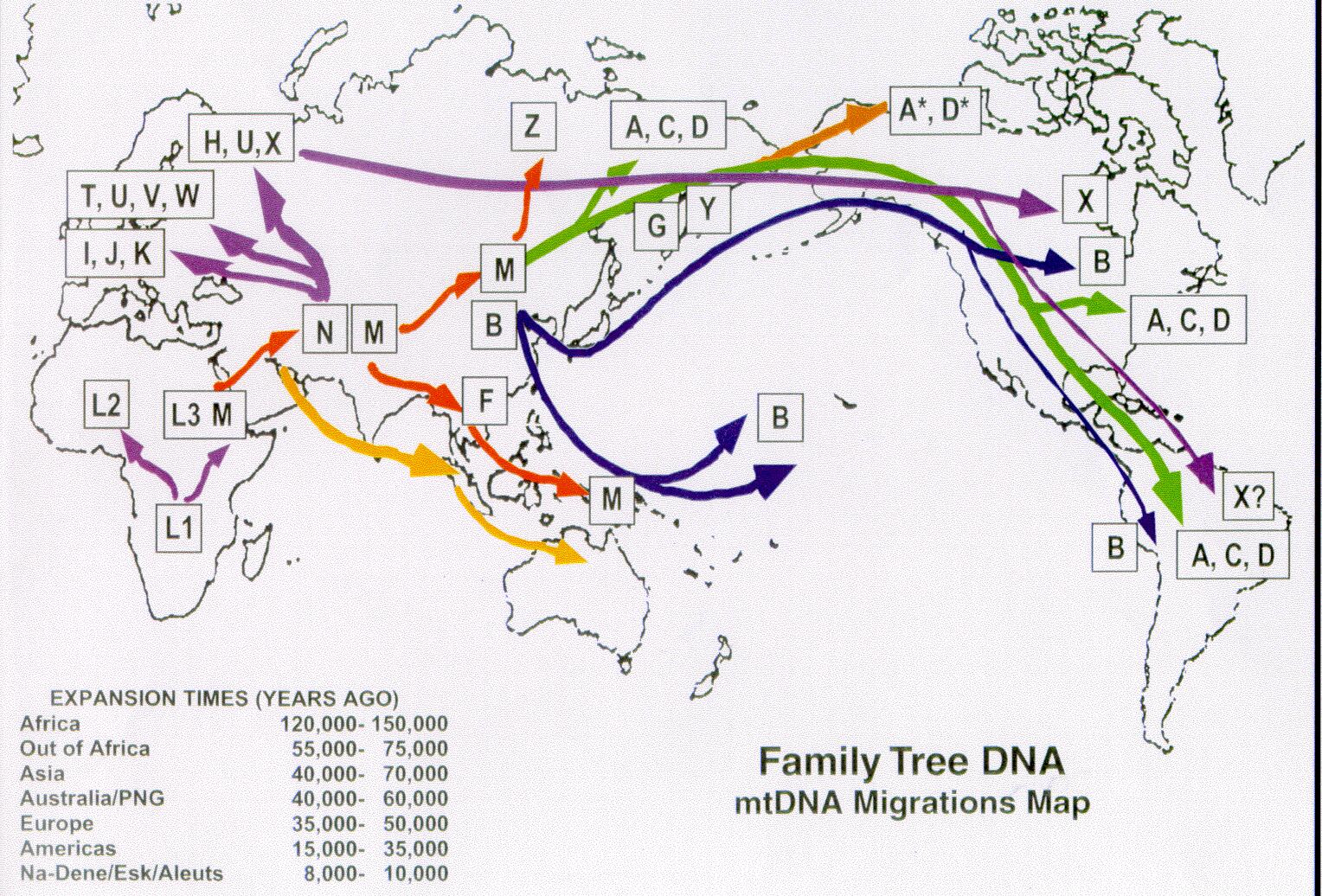 KAYNAKLAR....::  Bu arada kaynakalrı belirtiyorum...) Bu arada kaynakalrı belirtiyorum...)http://www.roperld.com/FranklinGenetics.htm http://www.roperld.com/ropergenetics.htm http://www.roperld.com/mtDNA.htm mtDNA göre bir mutasyon olamaz bu yönde haklılardır..Çünkü mtDNA ve rRNA bir mutasyon olsaydı bir tür yaratık ortaya çıkaracaklardır..Çünkü mtDNA - rRNA Roper Genetics Project - Franklin Genetics Project - Little/Klein/Cline Genetics Project bu yapılan çalışmalarla ortada bir ispat var ama EVrim değil..Ortadaki bir ispatı tam olrak göstermektedir.. http://cita.chattanooga.org/mtdna.html Bu linkte Amerika ve eskimoların ataları nerden geldiğini yazmaktadır..Onlara göre bir Asyalı türden meydana geldiğini yazmaktadır... 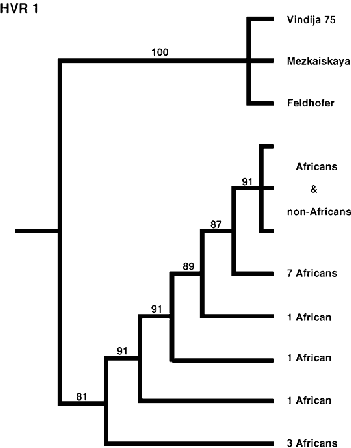 Buradaki talkorgins kaynağında belirtiği gibi bir ataları olmaları lazımdı..Ama ata kelimesi tüm türlerde değil tek insanlarada geçmektedir..Çünkü bir araştırma sonuçu bunu bir hata olrak kabul etmelerin nedeni ağaç ve hsatalıklardı.Bu mtDNA bir bir atamızın olduğunu anlatmaktadır...Bu mtDNa dağılmasıyla insan ırkı meydana geldiğini açıkça ortayua koyuyor..Peki bu evrim midir.?.  http://www.worldfamilies.net/mtDNA.htm http://www.talkorigins.org/faqs/homs/mtDNA.html http://www.pbs.org/wgbh/nova/neanderthals/mtdna.html Buradaki tesbitim evrim olmadığını gösteriyor.mtDNA bir bir ispatı ortaya koymaktadır..Bu evrim değildir... "Hatalar o kadar yaygın olabilir ki genetikçiler insan popülasyonları ve evrim çalışmalarında yanlış sonuçlara varıyor olabilirler. Forster’ın, dizilimlerin değişimine göre oluşturulan evrim ağaçlarını kapsayan hata-araştırma yöntemi, bu hataların çapını eksik tahmin ediyor olabilir." , Carina Dennis George Washington Üniversitesi paleoantropoloğu Alison Brooks, "Bu tarihler fosil kayıtlarında ortaya çıkan göçlerin coğrafyası veya sırasıyla uygun düşmemektedir" https://www3.nationalgeographic.com/...hic/atlas.html Türklerin göçlerine göre mtDNA yayılması göstermişlerdir..Bu şekilde bir iddaa olablir mi... anlamadığım insan o zamanda evrimleşmedimi.? Türklerin boğazdan geçerek eskimoları sonra da kızılderileri oluşturmuştur...Çünkü inançları aynıdır..Salakça bir iddaadır..Eskimolar ve Kızılderilere bakıldığında bunların inançları şamanist inançtır..Bu şamanist inanç ise o zaman bunlar bir arada geldi ama  ırklarını oluşturan Türklerdir.Bu yönde ATATÜRK'ün bir araştırması vardır..onu inceleyenin öğrenirsiniz..Kayıp kıta Mu ve Türkler..Türklerin inanç Şamanis bir inançtı, kızılderi ve eskimolarda inançları şamanist bir düşünce sahiplerdir..Bunlar göçler olmuş ama söyledikleri tarihlerde değildir.... http://www.apologeticspress.org/articles/2734 http://www.apologeticspress.org/articles/2332 Problem olan, uzakta araştırmacıların hayal etmiş olduğundan daha büyüktür. Ne yazık büyük bir hayal sona erdi... Evrimcilerin dediği gibi yapının olmadığını gösteriyor. Dr. Forster yaptı çalışmanın mtDNA düşündüğü gibi olmadığını söylemektedir...Bunun bir hata olduğunu ve üzücü bir sonuç olduğunu kabul etmiştir.. Kod:
The DNA sequences pouring in from sequencing projects have fueled the effort and extended the clock approach to many genes in the cell nucleus. But the wash of data has uncovered some troubling facts. It’s now clear that in many cases, the main assumption underlying molecular clocks doesn’t hold up: Clocks tick at different rates in different lineages and at different times.... For the clock to work with either sort of DNA [nuclear or mitochondrial—BT/BH], nucleotide changes must tick away steadily so scientists can convert the number of nucleotide differences seen between two organisms into the number of years since they diverged. Different genes evolve at different rates, depending on the selective forces upon them, but the model requires only that each gene’s clock maintains its own rate. Early work hinted that this might not always be true, and now a plethora of data shows that many genes don’t conform to this model """he problem is far bigger than researchers had imagined. The mistakes may be so extensive that geneticists could be drawing incorrect conclusions to studies of human populations and evolution"""" Rastgele bir oluşum olsaydı bu büyük bir hata olacaktır..Çünkü mtDNa o zaman yanlış bir nüfus ortaya çıkarmaktadır..Olmaz yani anlayacağın... Yazının devamı gelecektir.. Çalışmalarım sürmektedir..Çeviriler ve kitaplardaki yazıları sizlere vereceğim...Şuanlık yeterli dir.. [Mt]METEE[/Mt]Kalp ne ile doluysa,dudaklardan 0 dökülür gider.Goethe EVRiM HAYALGüCüDüR?...
|
 |
| Önerilen Siteler |
«
önceki Konu
|
sonraki Konu
»
 Normal

|
|

Bütün Zaman Ayarları WEZ +3 olarak düzenlenmiştir. Şu Anki Saat: 01:50 .